Geometry & exchange
Eight native/STEP states, nominal assembly/motion checks and native mass properties.
Inspect evidenceThe evaluated configuration is VOLLEY-G5-ACR1. Geometry, motor/circuit behavior and orbital delivery use explicitly identified models and source files.
Eight native/STEP states, nominal assembly/motion checks and native mass properties.
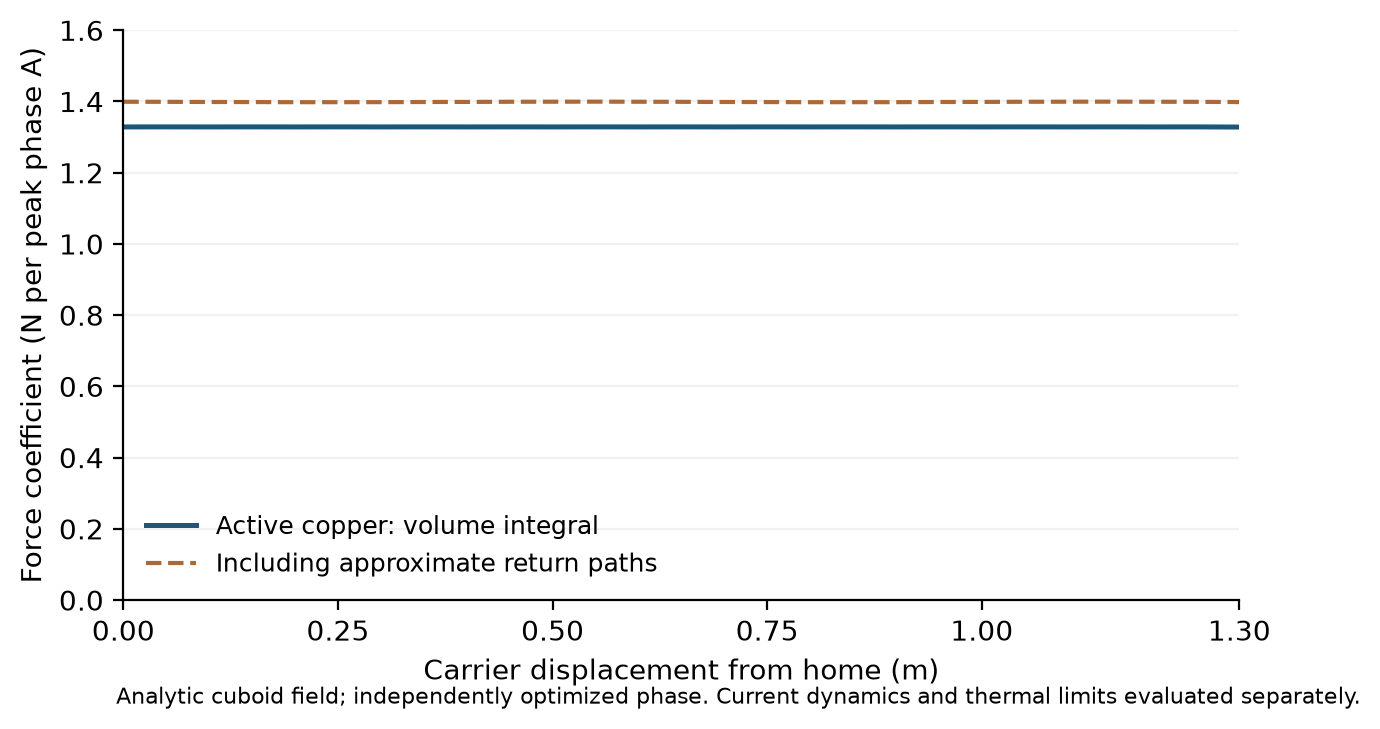
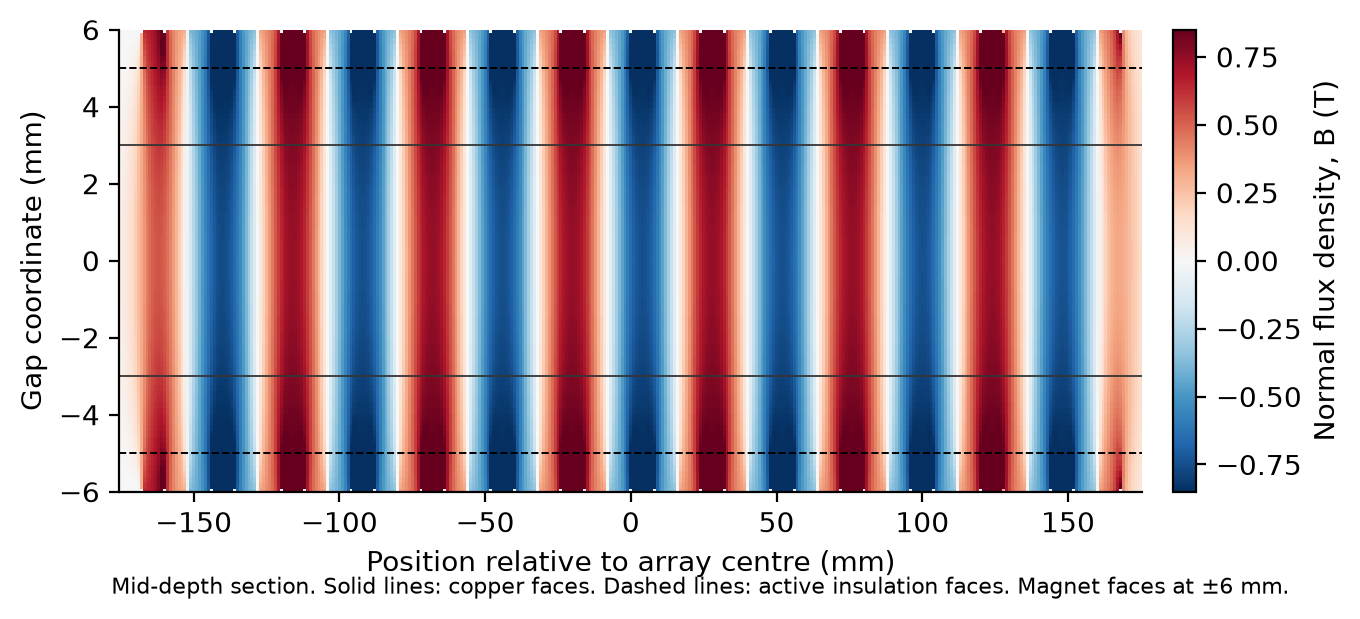
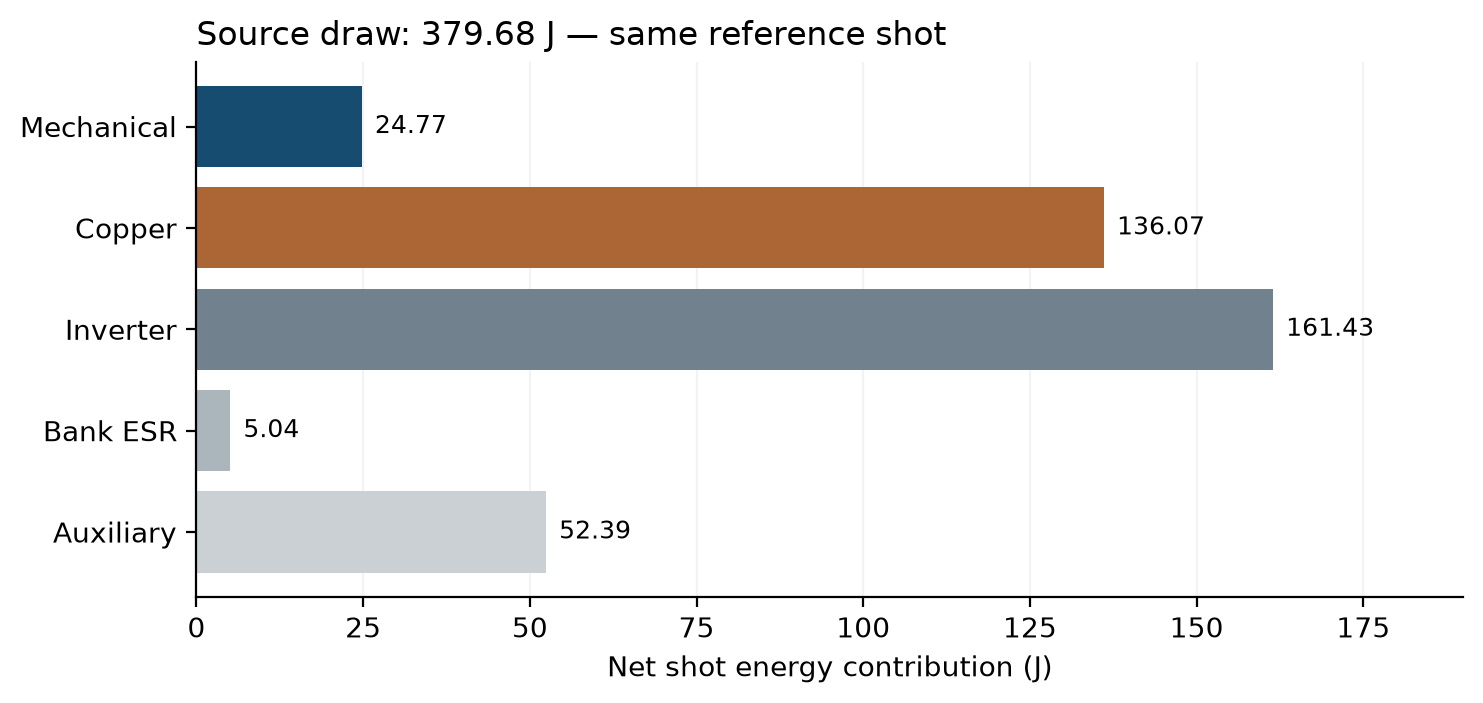
Inspect evidenceFinite motor geometry, source/current/voltage model, arrest and explicit installed allocation.
Inspect evidenceFrozen synthetic target states, release recoil, continuous host arcs and native Orekit replay.
Inspect evidenceExact report plus original scientific figures and controlled Blender views.
Inspect evidence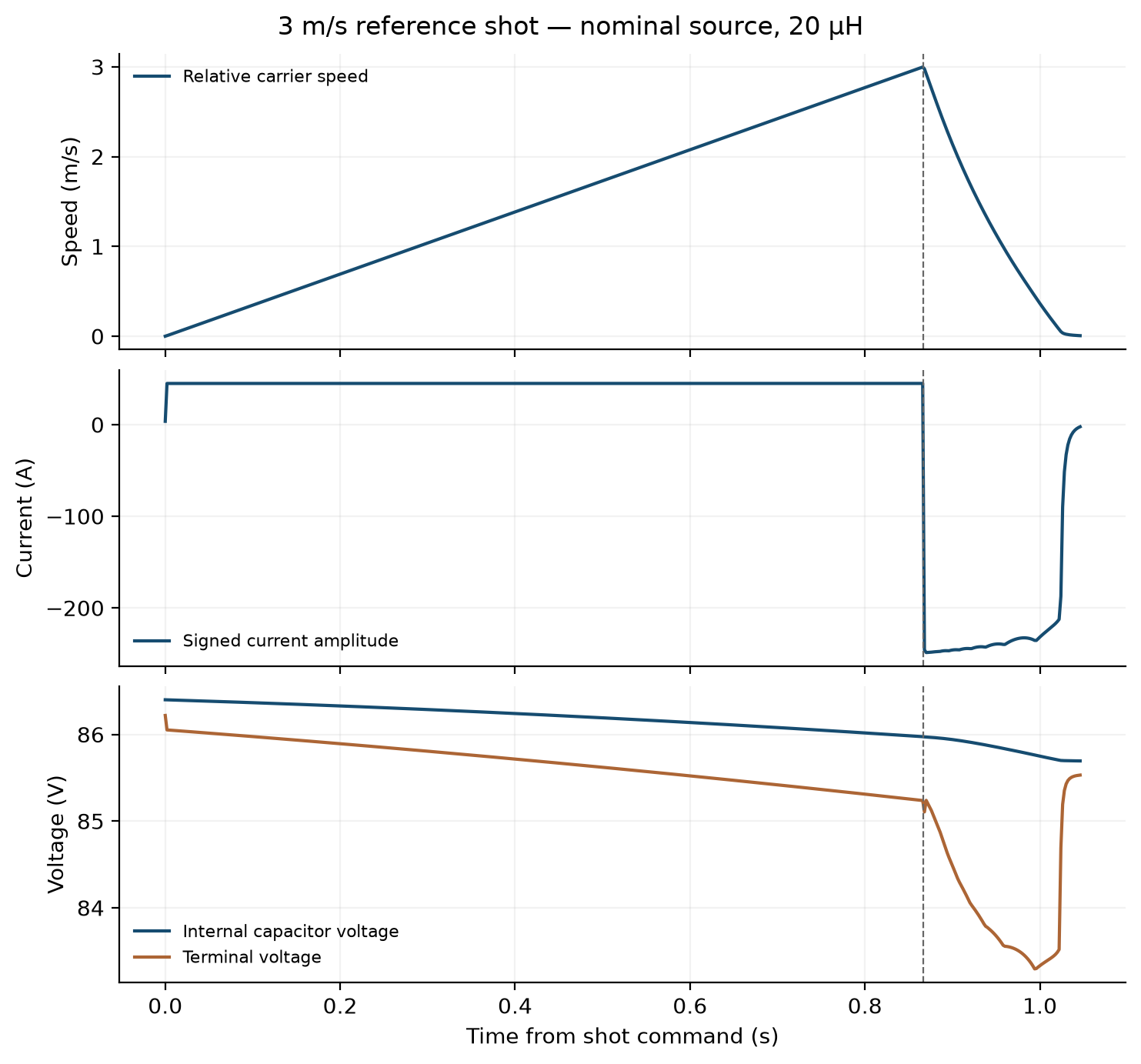
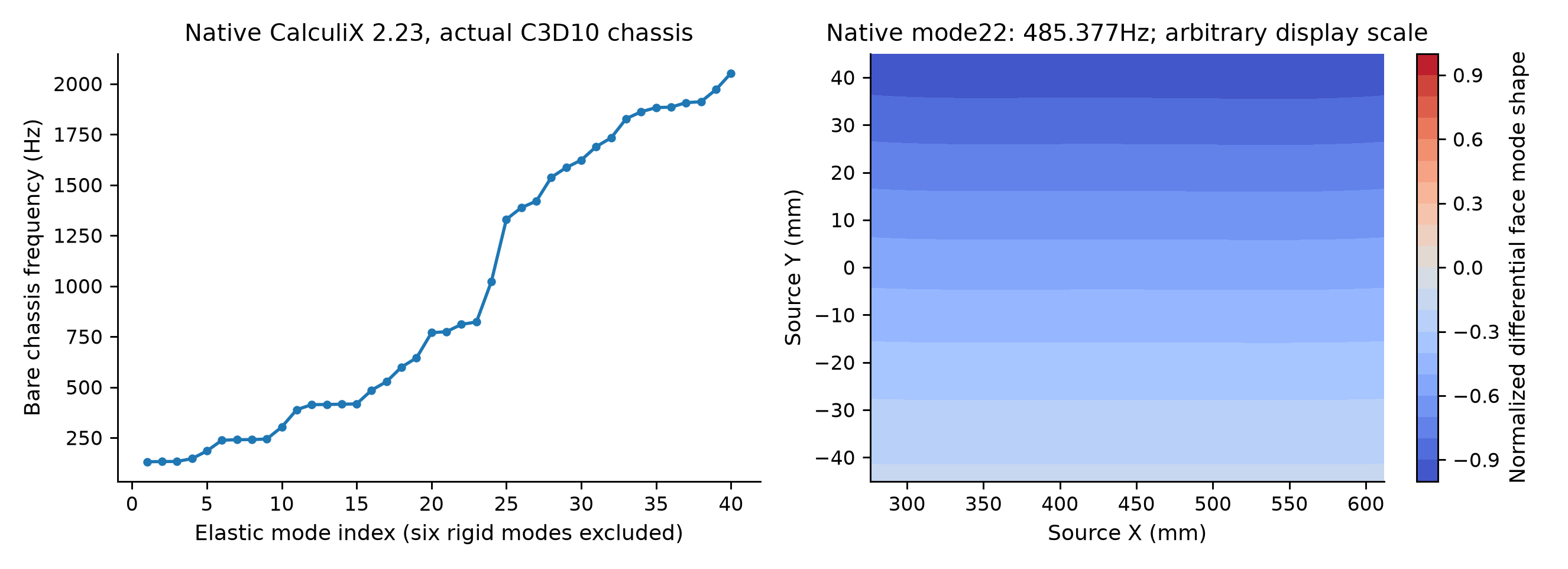
Forty elastic modes, finite forcing, phase-dependent normal reaction and conditional clearance.
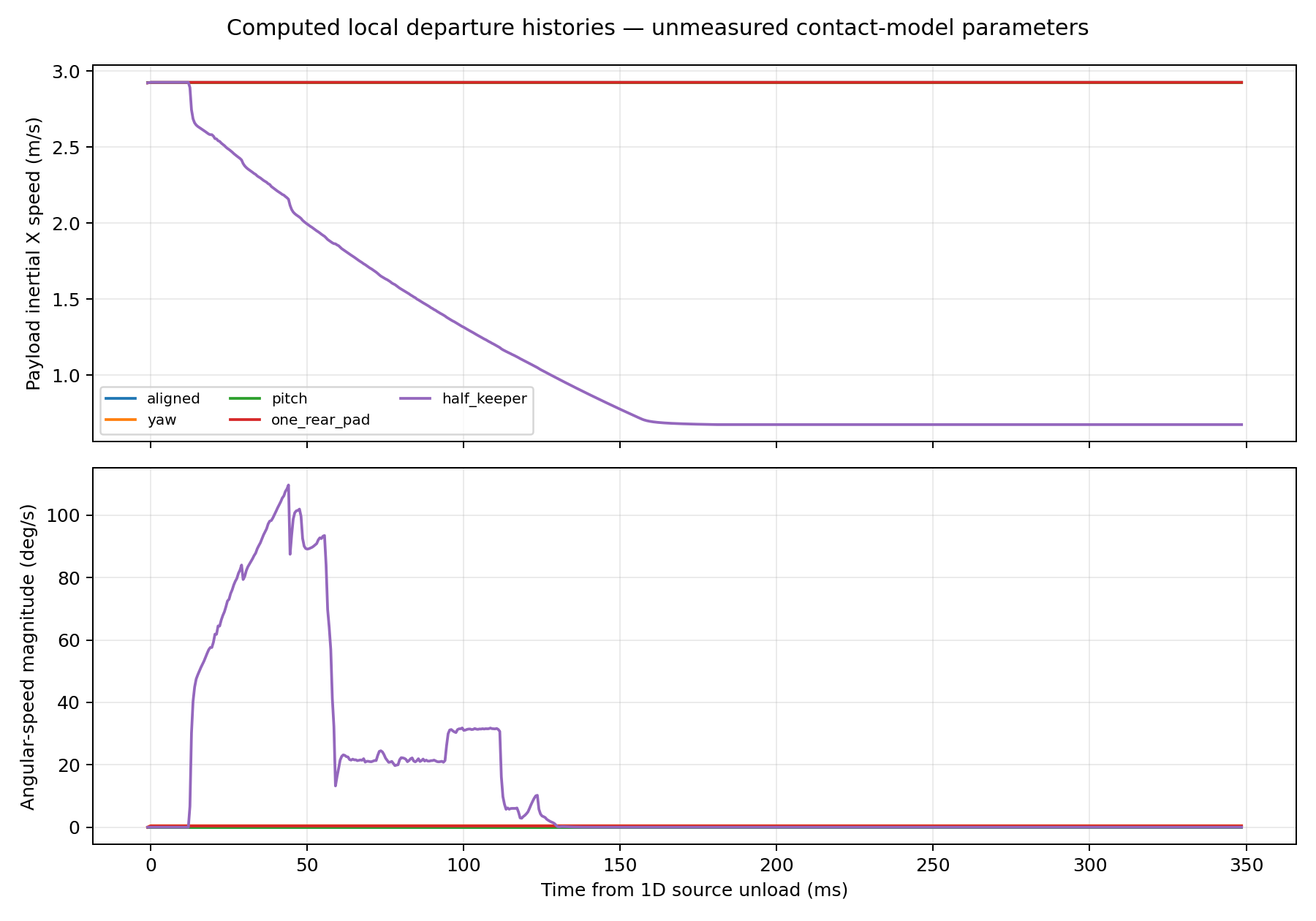
Methods and native results ↗Forty-two native runs with local egress, contact/refinement and keeper-catch sensitivity.
Histories and interpretation ↗CAD-based radiation, repeated duty, regulated host heat paths and a separately identified voltage-derated source.
Conditions and computed limits ↗Finite host authority, release policy, covariance, native orbit lifetimes and independent engine-only disposal.
Campaign and resource study ↗These separately identified supplements preserve the accepted ACR1 core and ED1 document identities. Numerical output, proposed fixture geometry and physical measurements are distinct evidence classes.
Two- and four-payload campaigns extend the retained twelve-payload reference: 28 finite-force candidates and 17 native Orekit replays, with full hardware mass retained.
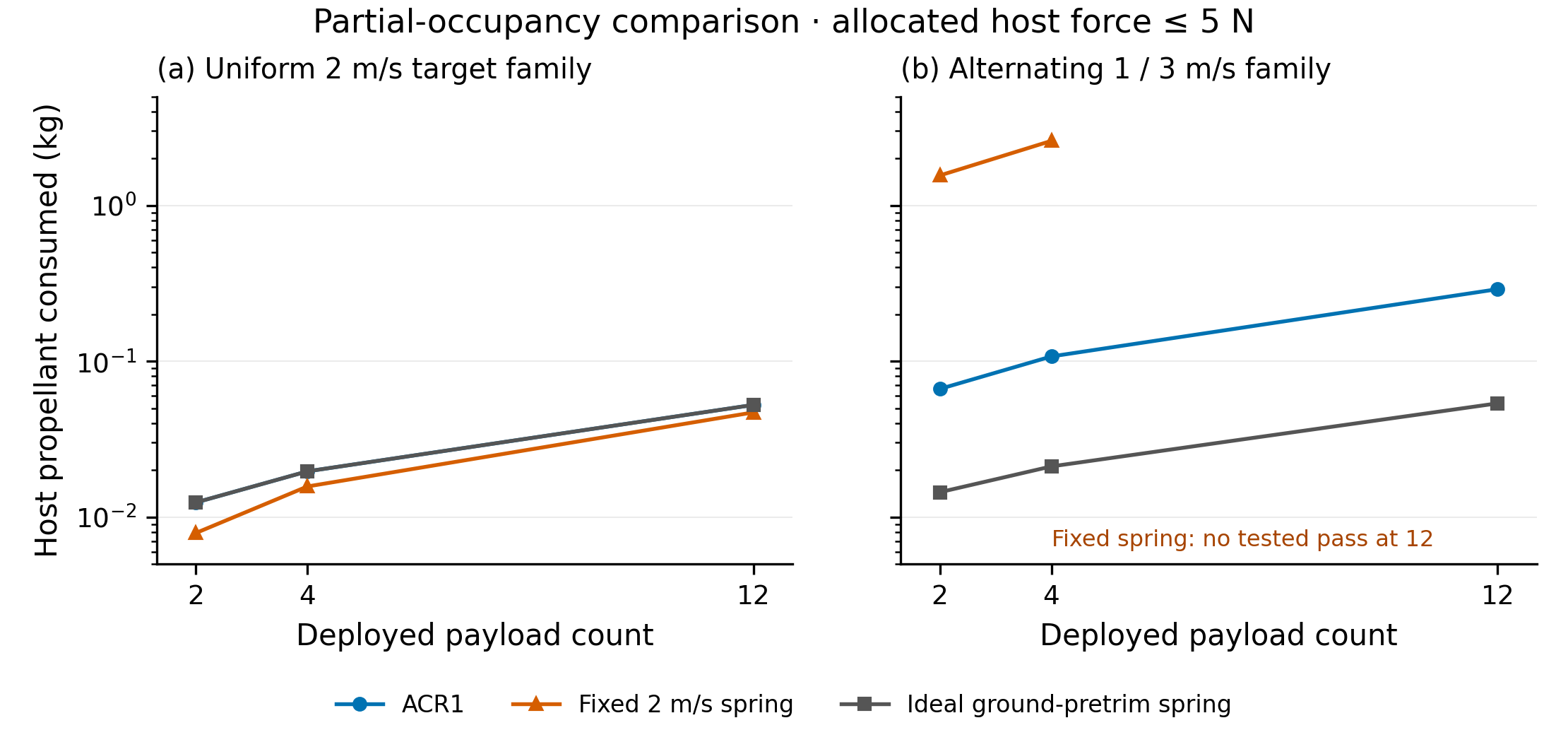
Methods, full-state results, native replay and resource comparison ↗
The primary ANSYS bare-chassis result gives 0.286392 mm paired closure under matched 3.01048 kN opposed-patch loads: 0.143% above the CalculiX reference. Three mesh levels and 11,448 independently read primary samples accompany the comparison.
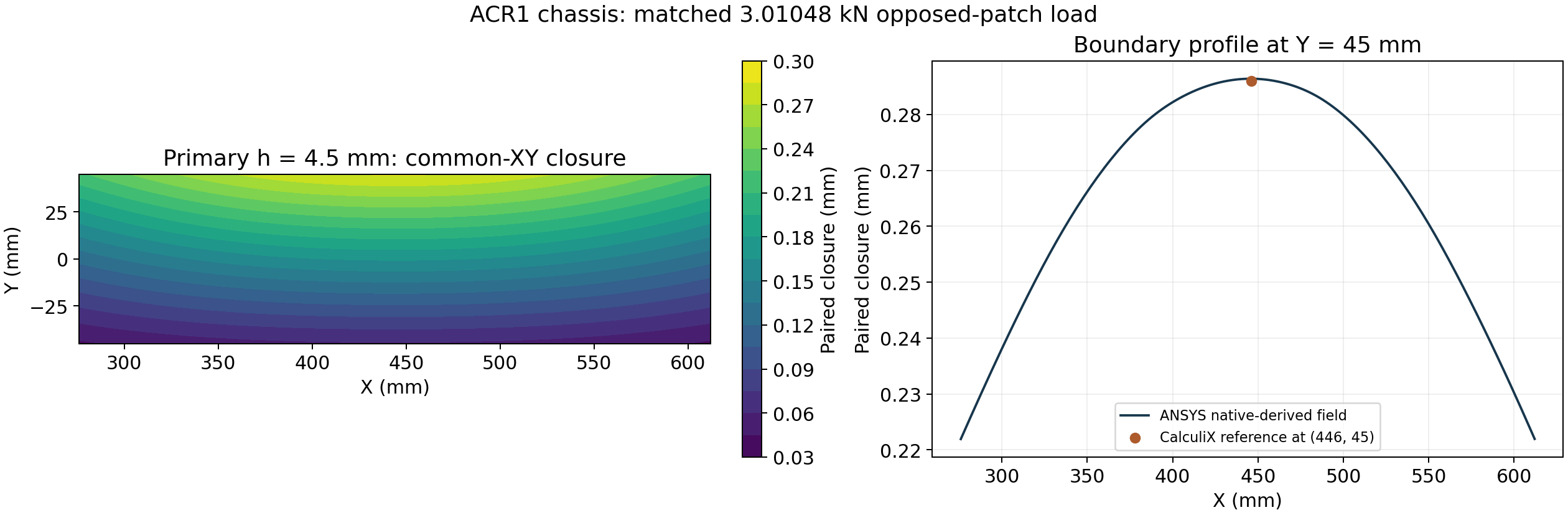
Read the inputs, mesh sensitivity, clearance-budget effect and source data →
Native solid geometry, nominal motion, interface retention and declared analytical sizing. Reference actuator envelopes and allocations are identified in the source; manufacturing and instrumented hardware correlation follow.
Finite geometry and coupled computational source/motion models. The 1–3 m/s command band is the supported study range; no hardware rating or flight capability is asserted.
Fixed-axis J2 point masses, synthetic preplanned full-state targets, constant inertial host force and Isp 220 s. Drag, higher gravity, attitude/plume allocation, navigation and finite exit geometry are outside the mission model.
Independent replay and step refinement assess numerical consistency. They do not establish physical delivery accuracy, measured reliability or payload compatibility.
149.55672 kg computed CAD mass + 7 kg power/control allowance = 156.55672 kg retained device allocation; + 48 kg payloads = 204.55672 kg loaded device. The generic wet host is 500 kg including its 20 kg fuel once, so the mission begins at 704.55672 kg.