VOLLEY / Engineering evidence

What the orbit software shows

Native GMAT lunar coast study

GMAT R2026a integrates 18 prescribed lunar cases at one TAI epoch and two MJ2000Eq planes. Of twelve requested 180-day coasts, seven reach the 1,737.4 km reference sphere and five reach 180 days. Six additional high-degree or alternative-field cases reach 30 days.
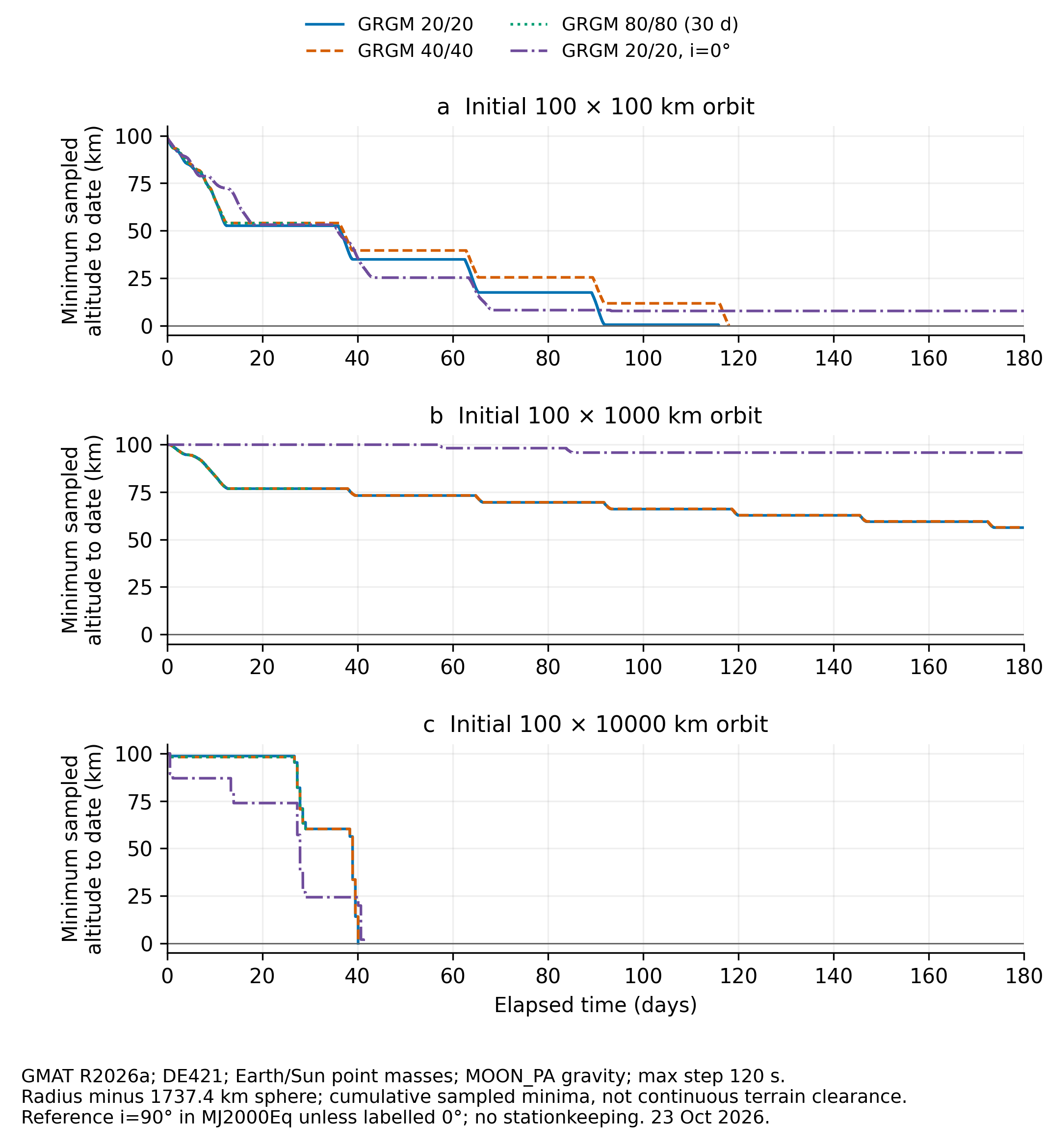
Native GMAT sampled lunar altitude histories, with first reference-sphere stops and bounded coast horizons
LNC01: sampled altitude above a spherical lunar reference. Terrain, general orbital lifetime and spacecraft operational survival are outside this model.
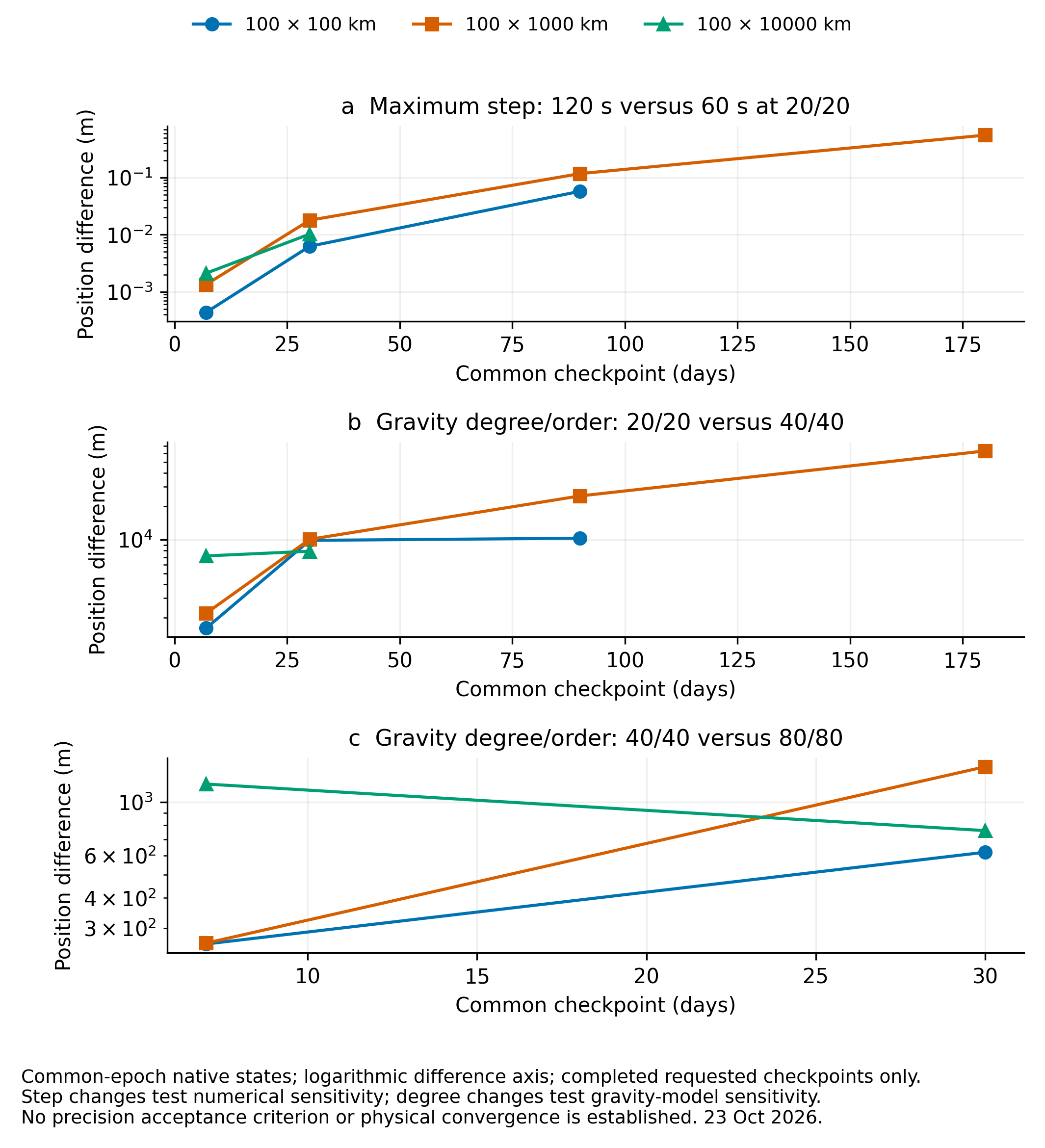
Time-step and gravity-field refinement effects on native GMAT lunar trajectories
Numerical sensitivity and gravity-field truncation effects are shown separately. Small time-step changes do not establish physical model convergence.

Native decks, lossless raw histories, source identities, report and capture checker.

A 4 kg payload, a 300 kg remaining host and a 450 km circular reference. These runs test prescribed release states and numerical propagation. They do not demonstrate a working launcher.

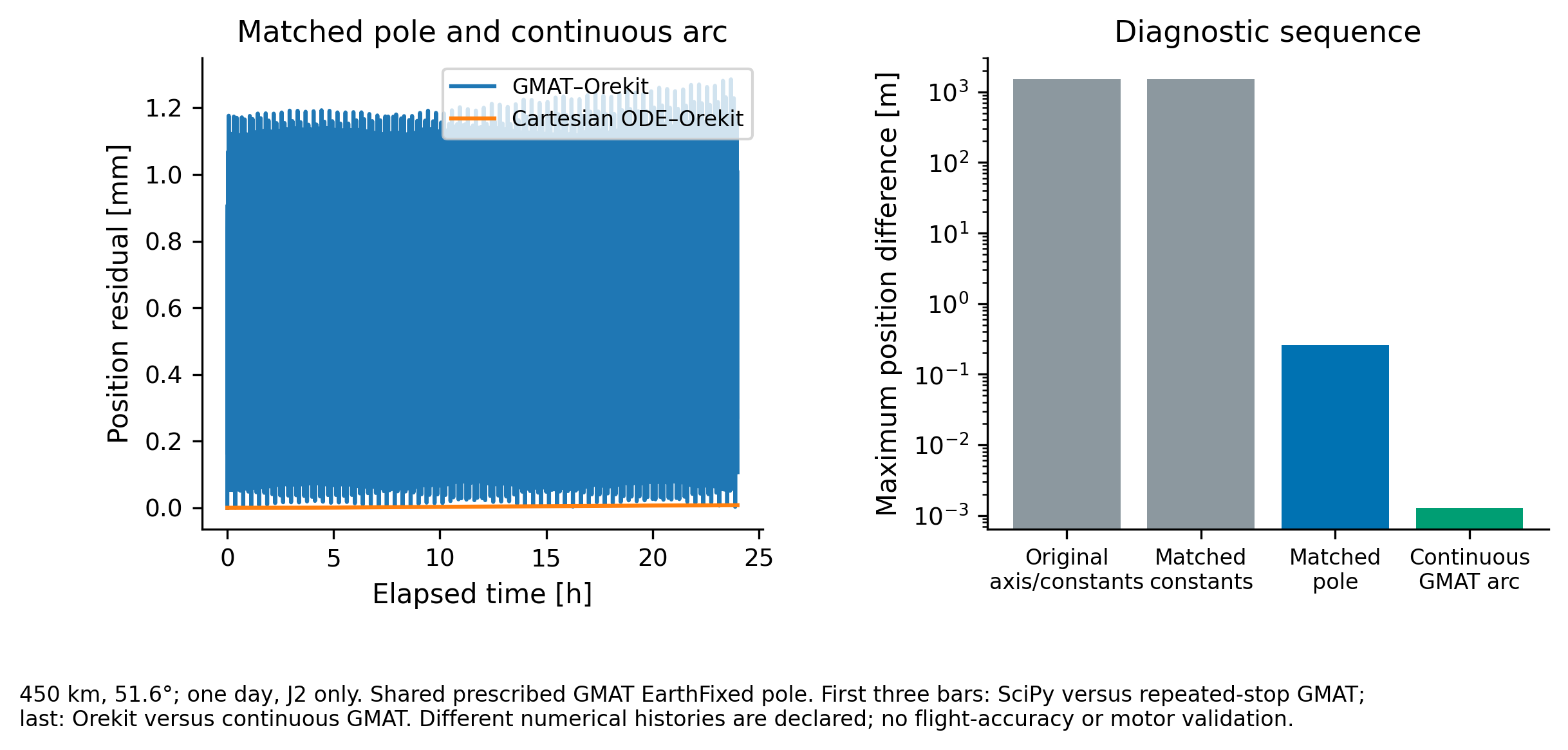
Executed: Orekit 13.1.6 and GMAT R2026a. 19 October follow-up: the dominant J2 pole/gravity mismatch is isolated below. Atmospheric lifetime, physical release accuracy and full flight-clearance validation remain open.

Open the interactive common-epoch explorer — play or step through the computed history.

Release changes the orbit and the relative motion
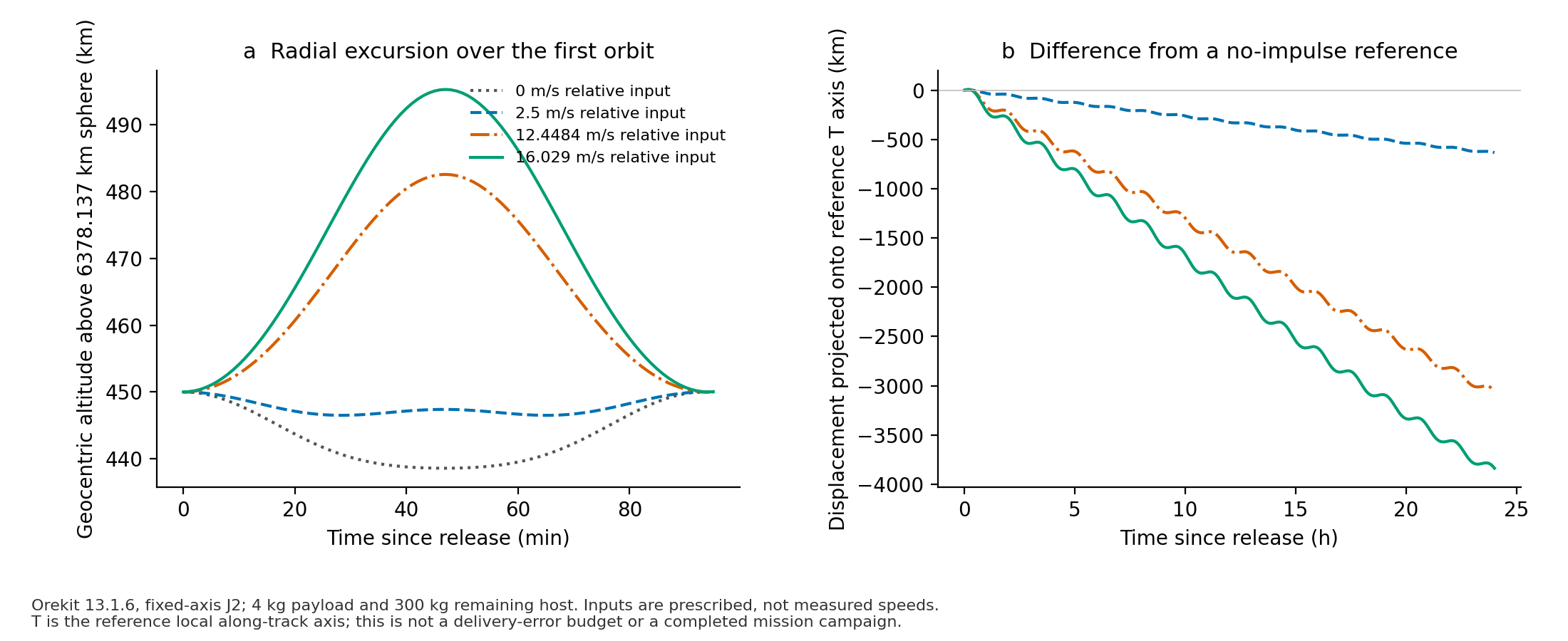
Altitude over one orbit and projected along-track displacement over one day for four prescribed release inputs
Native Orekit output. Relative separation speed is converted through finite-host momentum conservation. The displacement plot is a local coordinate component, not a service accuracy.

Compare the setups before comparing the answers
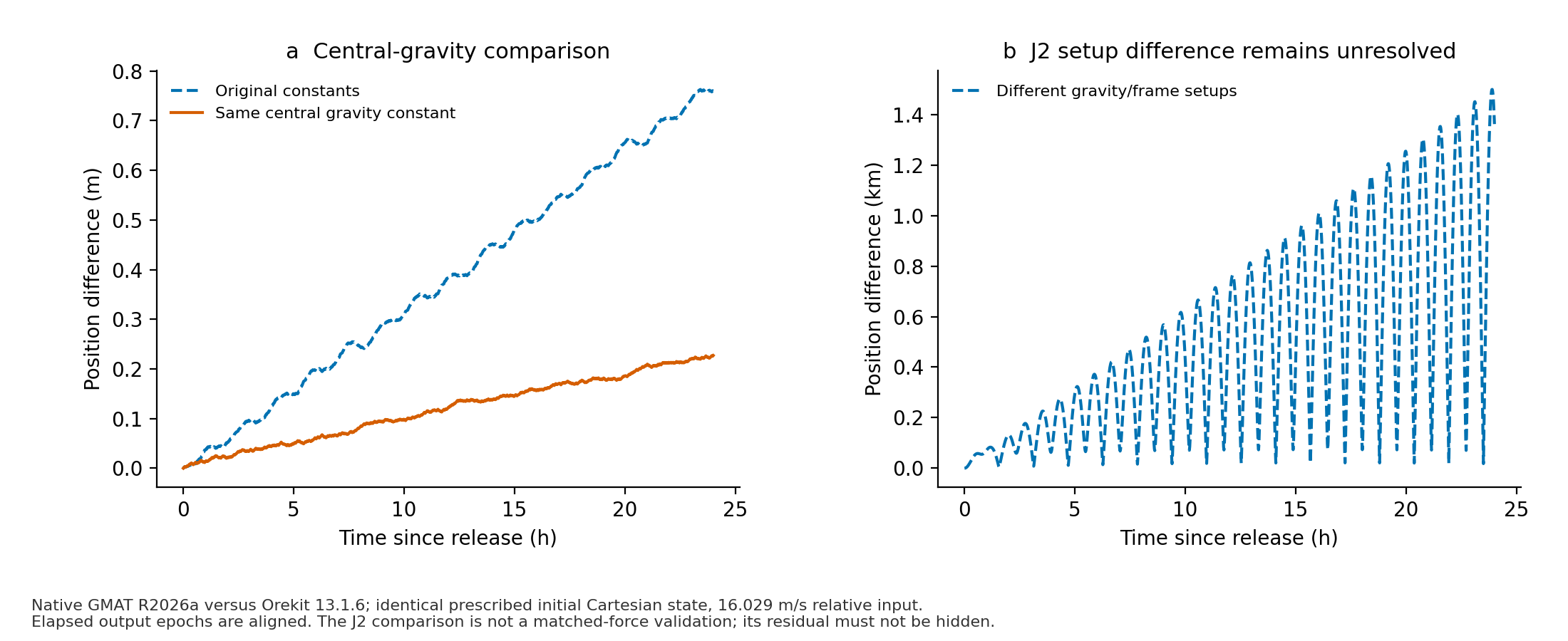
Central-gravity residuals and a separate larger J2 setup difference
The central-gravity comparison uses a common constant in the corrected case. This retained 18 October comparison has a roughly1.5 km J2 setup difference; it is not matched-force validation. The 19 October follow-up below isolates its dominant cause.

Matched gravity-axis follow-up

Matched GMAT and Orekit position residuals over one day and diagnostic ablation
19 October: matched JGM2 constants, shared prescribed EarthFixed pole and one continuous GMAT arc give approximately 1.285 mm maximum residual. Shared orientation and millimetre numerical agreement do not establish physical orbit accuracy.

Native inputs, raw histories, independent Cartesian calculation, refinement and PDF report.

Numerical consistency has a limited meaning
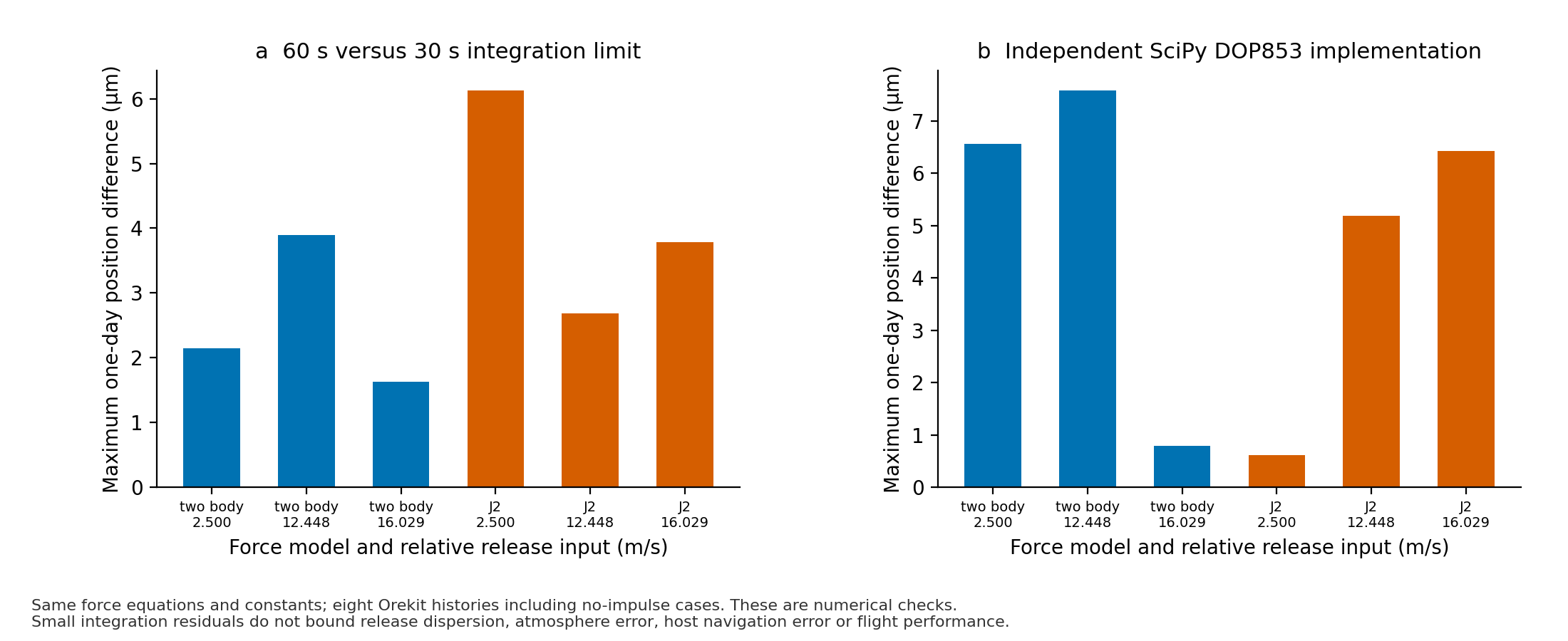
Integration step refinement and independent SciPy propagation differences in micrometres
Small integration residuals do not bound uncertainty in the real atmosphere, payload contact, timing, navigation or release speed.

The archived campaign has a different boundary
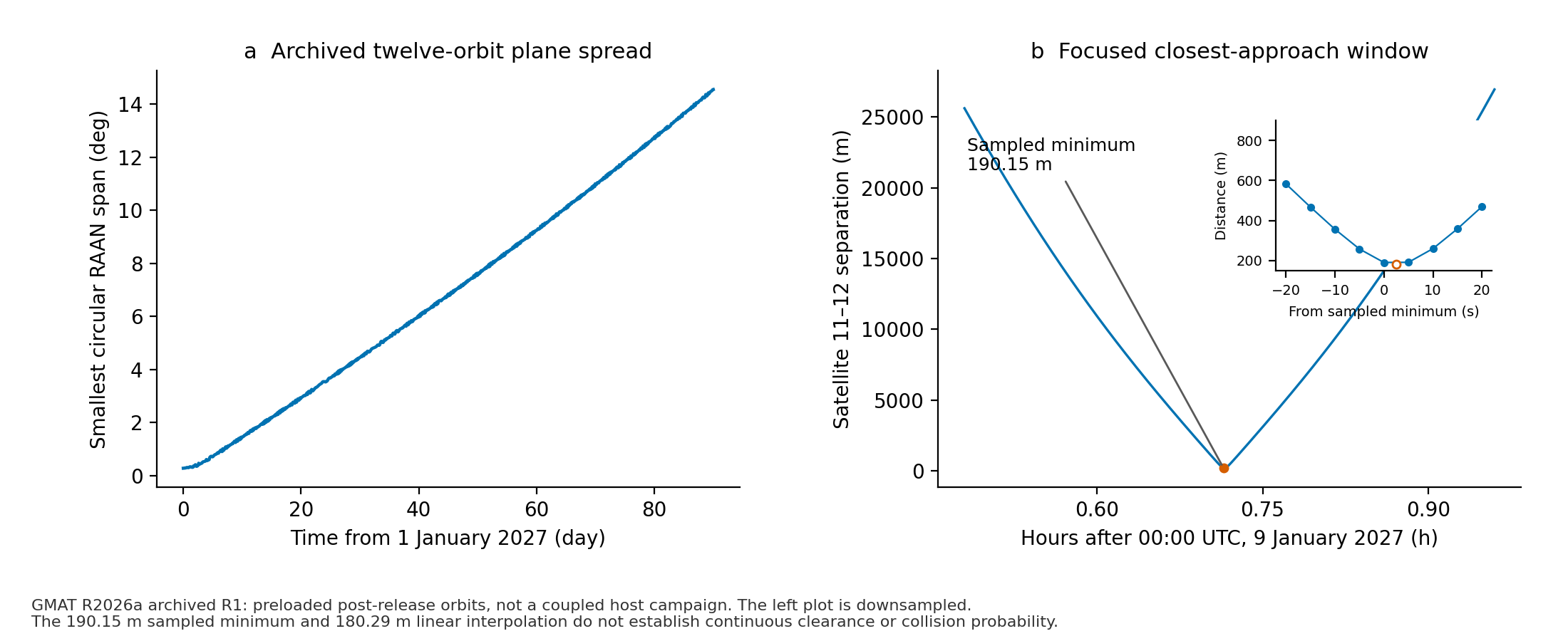
Ninety-day circular RAAN span and a focused closest-approach window with a sampled-distance inset
GMAT R1 starts twelve preloaded post-release orbits. The 190.15 m sample and 180.29 m interpolation do not establish continuous safe separation. The 2027 dates are simulation epochs, not flight records.

Coupled four/twelve-payload follow-up
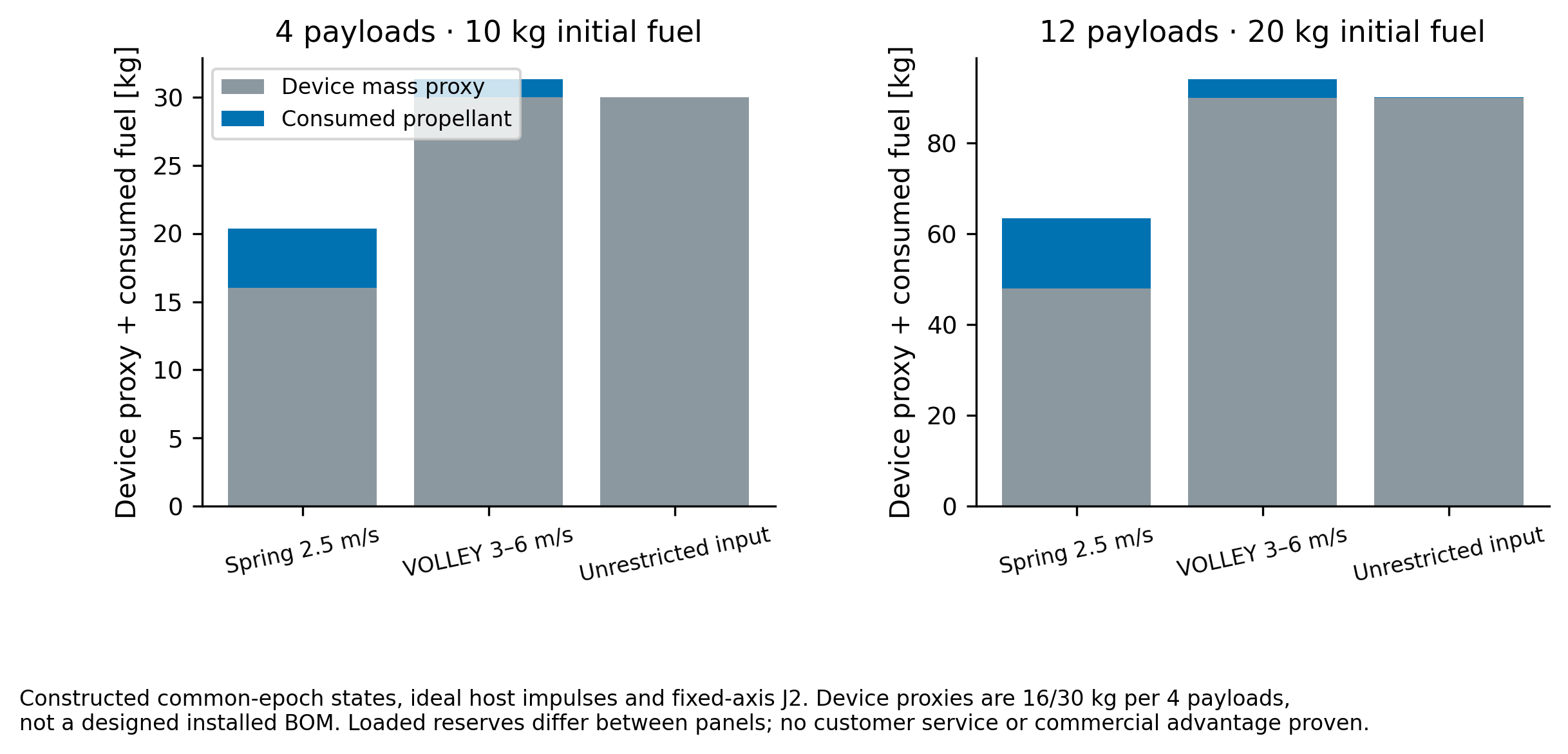
Device mass proxies and consumed host propellant for constructed four and twelve payload campaigns
Ideal-impulse host pre-burns, recoil, transfer and final-state restoration are counted. A larger-reserve spring case completes; VOLLEY fuel savings do not recover the assumed device-mass penalty. Targets and mass proxies are not a customer mission or an installed design.

Raw campaigns, resource countercases and conditional nominal-clearance method. Feeder CAD and mechanical evidence.

Inspect the evidence

Source, raw histories, result tables and five-page PDF. The same evidence is local to the thesis and paper repositories. Plots are numerical exports; none is presented as a graphical-application screenshot.

CNR-01: complete native campaign replay and precision budgets

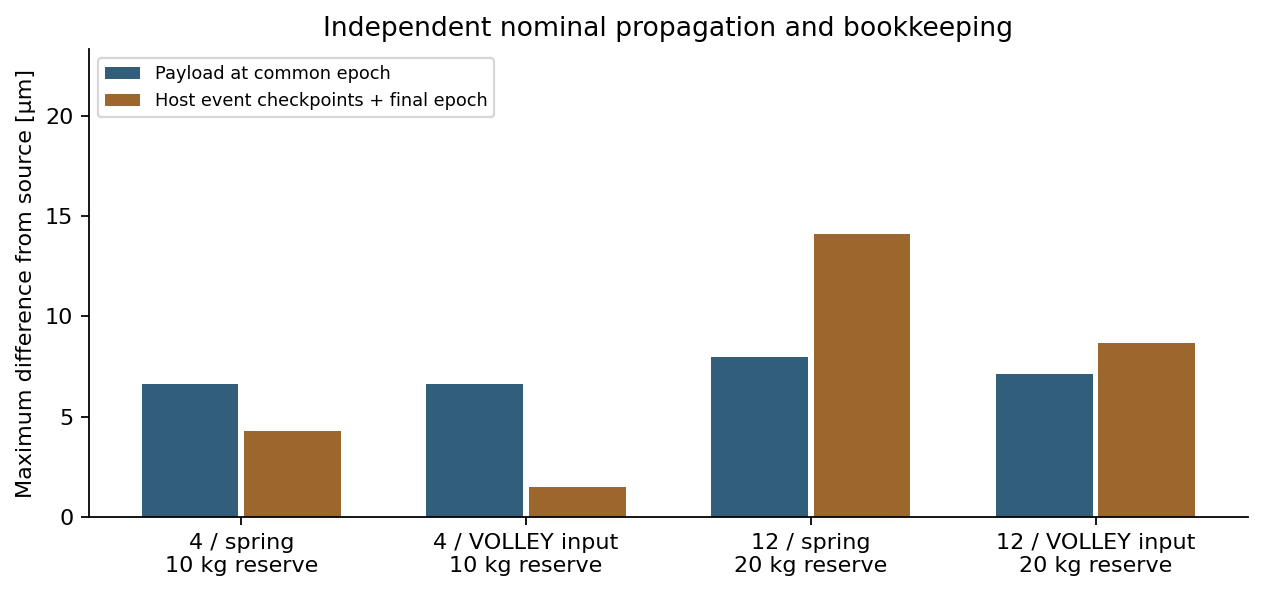
51 native Orekit cases replay prescribed host burns, rocket mass loss and parent/child recoil from one initial host state. Nominal payload endpoint differences are below 8 µm; this verifies numerical consistency, not physical delivery precision. Commands and constructed targets are shared with the source calculation. Both implementations use DOP853.
nominal consistency
Independent nominal numerical differences; fixed-axis J2, point masses and ideal impulses. No physical accuracy claim.
control sensitivity
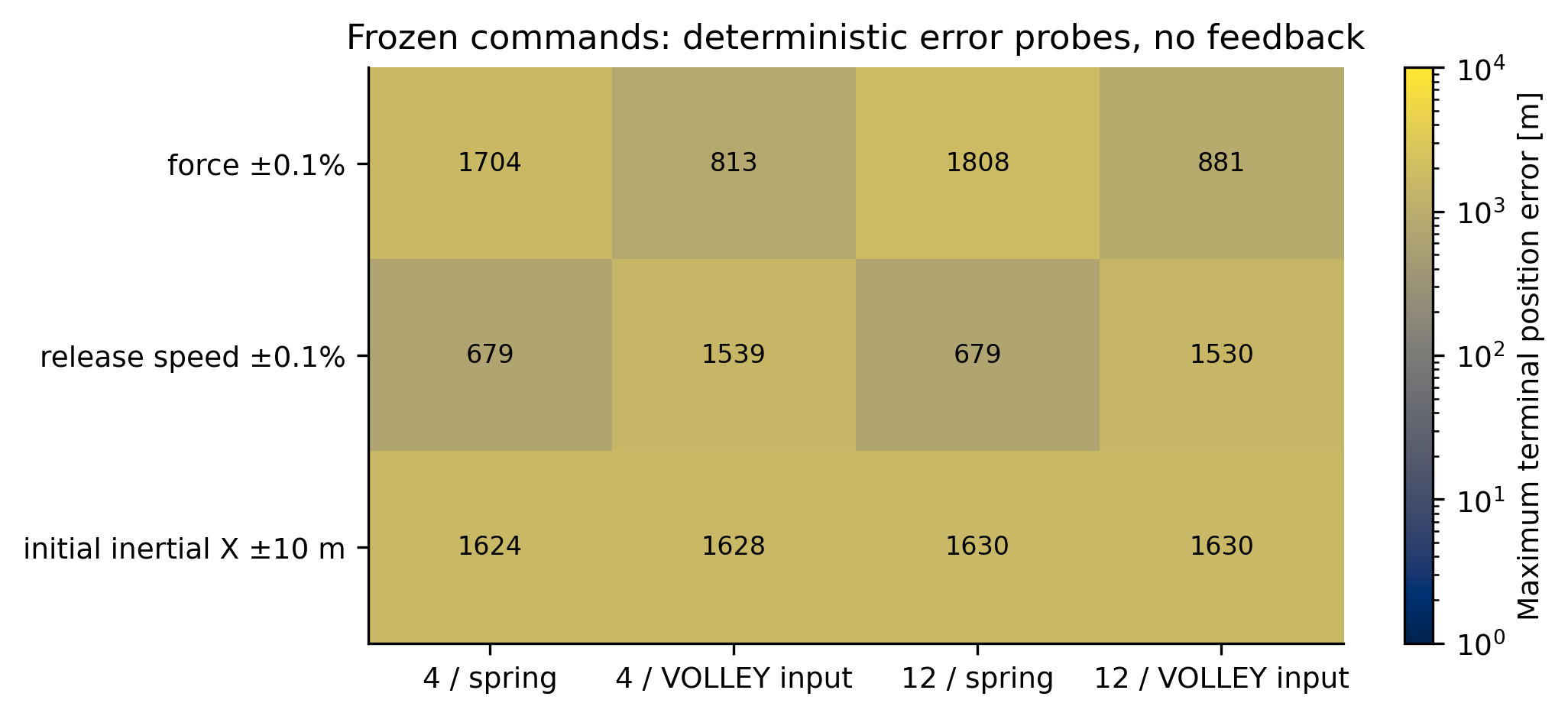
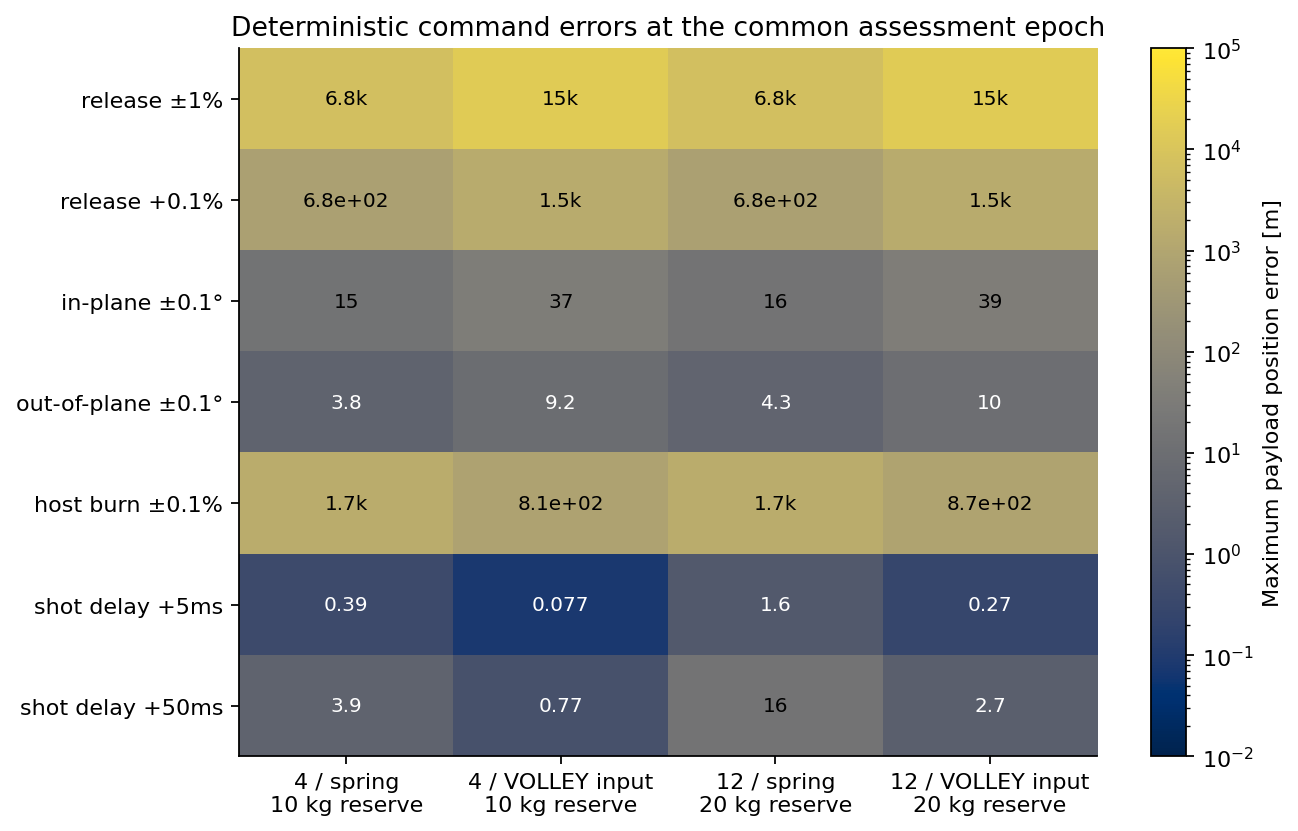
Deterministic probes with frozen commands and no feedback. A common +0.1% imposed release-speed bias gives approximately 1.53 km terminal position error in the VOLLEY cases. Values are maxima across the stated probes, not probabilistic bounds.
metrology budget
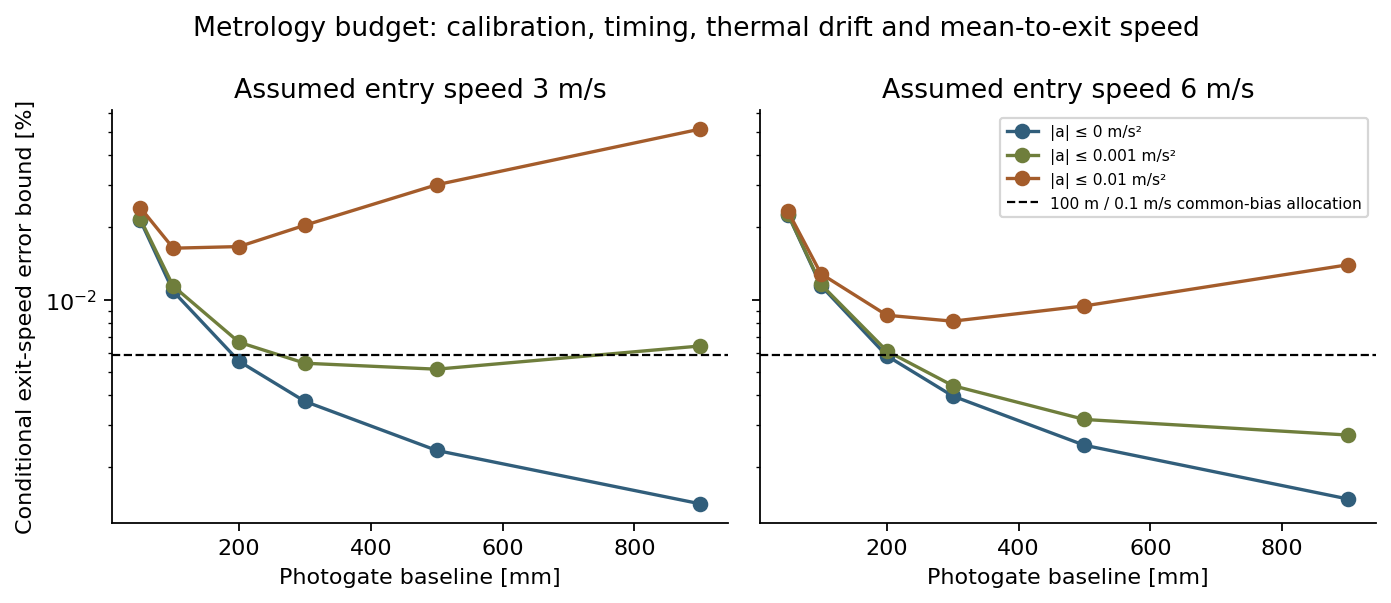
Conditional photogate/exit-speed budgets. Longer baselines also increase the mean-to-exit contribution when relative acceleration persists. No calibrated instrument or supported precision rating.
thrust time
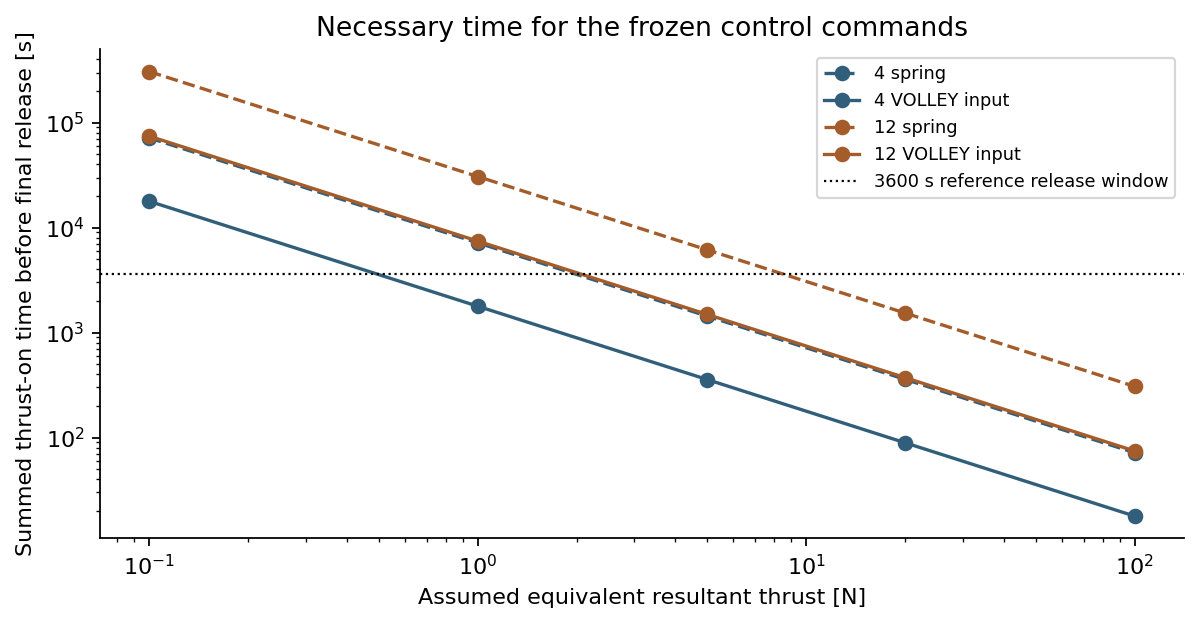
Necessary summed thrust-on time for the frozen impulse policy. FBR-01 below separately retargets finite-duration controls. Slew, feeding, plume and safety compatibility remain unverified; another spring-host strategy can change the result.

Self-contained PDF, source, raw events, native logs, sensitivity cases and dependency hashes. Actual motor/source ratings, closed-loop delivery, installed integration and provider acceptance remain unresolved.

FBR-01: finite-duration host targeting

18 targeted schedules and 46 native Orekit runs replace ideal host impulses with finite resultant-force windows, mass flow, preparation and recovery. Shared targets are assessed at one common epoch. No rated release speed or host compatibility is inferred.

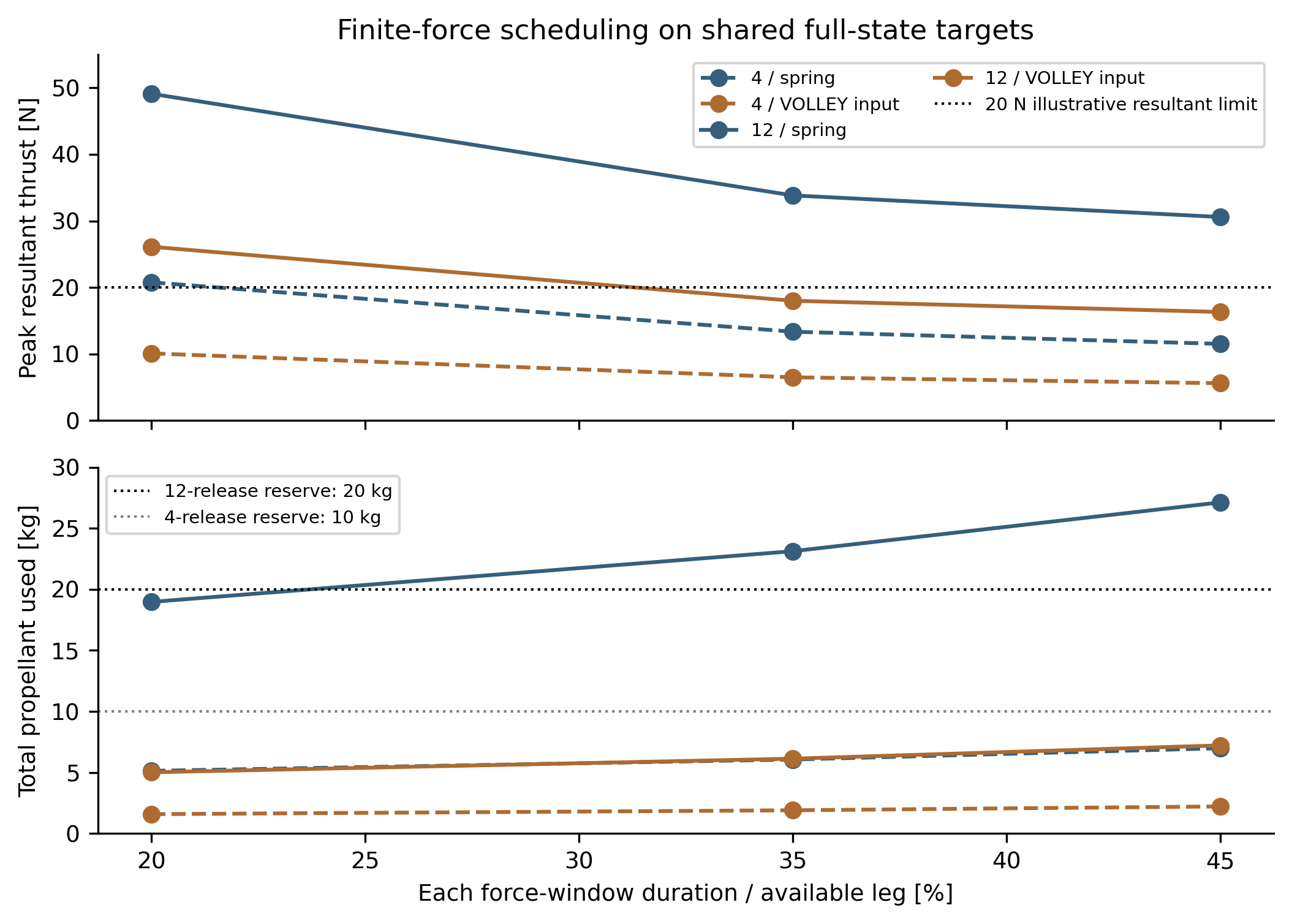
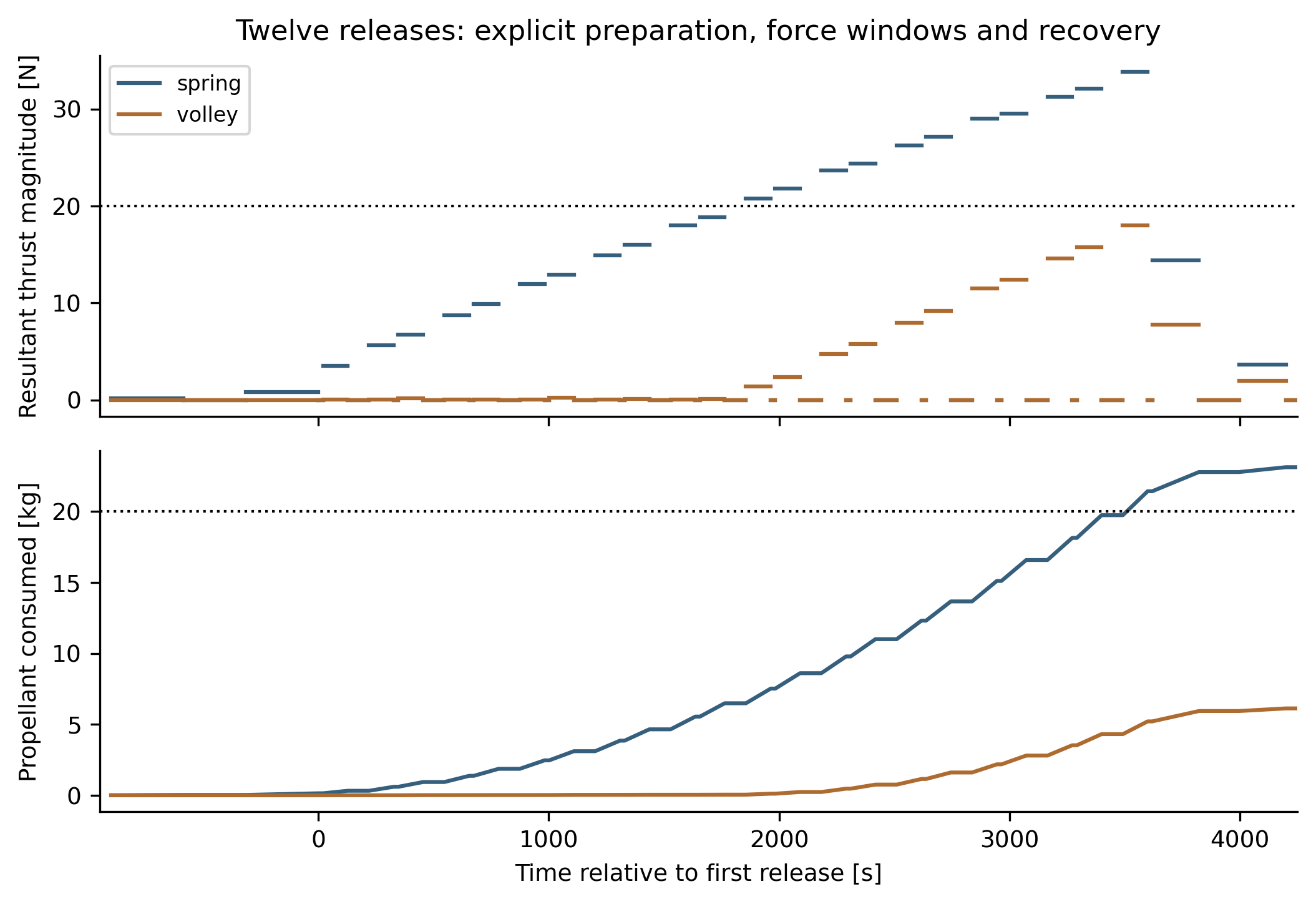
At the 35%/35% policy, twelve spring inputs need 33.83 N peak and 23.12 kg fuel; imposed VOLLEY inputs need 18.00 N and 6.12 kg. A common 30 kg reserve and 100 N limit lets both reach the constructed translational targets. The added VOLLEY mass proxy still exceeds its fuel saving.
force fuel trade
Each point is a separately retargeted force-window policy; failed thrust and fuel screens remain visible.
twelve chronology
Preparation, finite force windows, 20 s release guards and recovery are counted. Spring traces beyond reserve exhaustion are diagnostic only.
finite control sensitivity
Frozen-command force, release-speed and initial-state probes; deterministic errors, not calibrated precision.
slew requirements
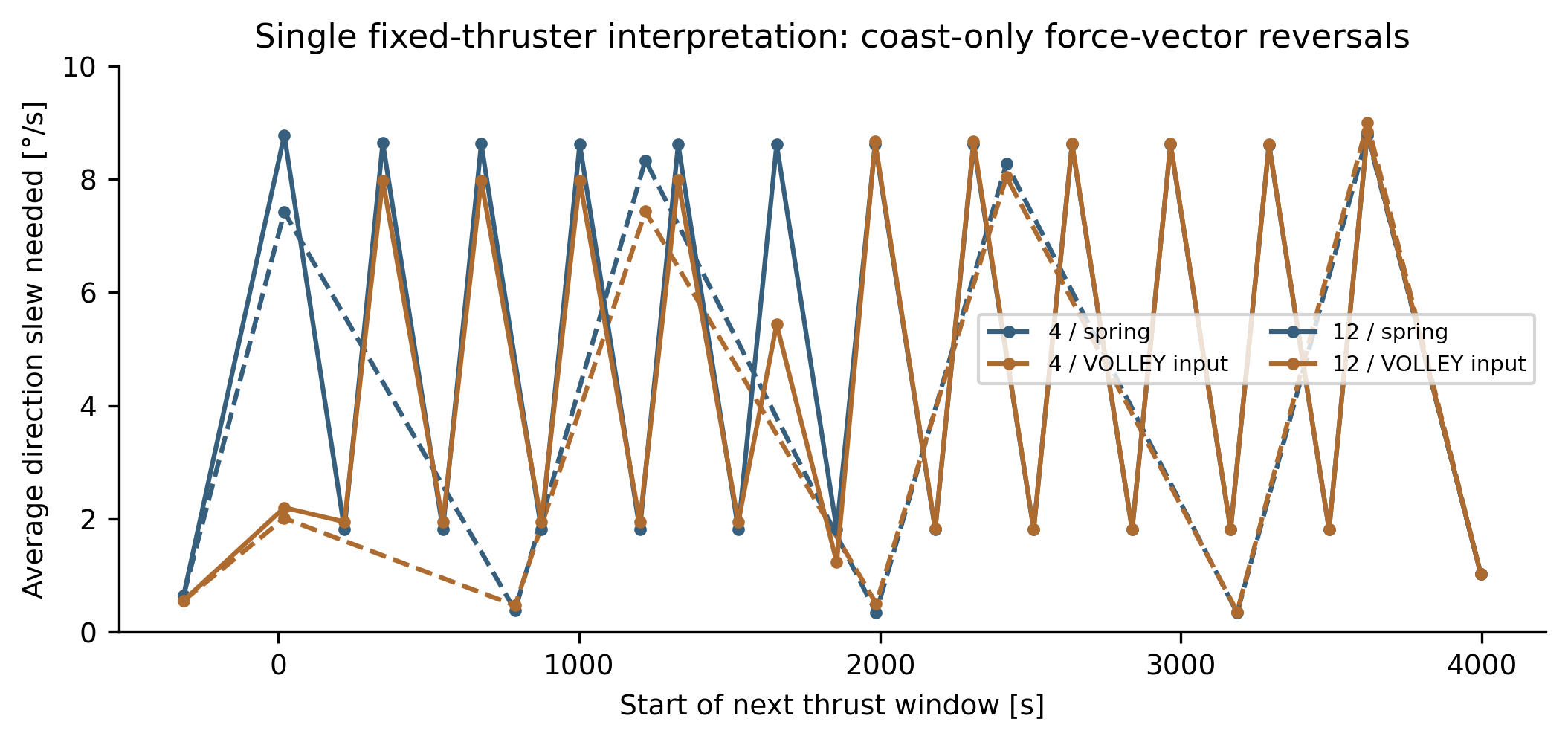
Single fixed-thruster interpretation requires nearly 9 degrees/s mean direction reversal in some gaps. Opposed thrusters may change this; no actual force/attitude allocation is selected.

Self-contained report, Python/Java sources, raw commands, genuine native logs and exact dependency hashes. Host pointing/force allocation, plume/body clearance, navigation feedback, actual installed hardware and motor ratings remain unverified.